Design work inside a landscape or construction operation tends to bottleneck in the same place. The skilled designers who should be developing concepts and meeting clients end up absorbing CAD drafting, model cleanup, and render queues, and that mix of high-judgment and repetitive production work is what slows project delivery. Process-Smart provides design production outsourcing that moves the repetitive production layer to a dedicated offshore design team, so your designers stay on the strategic and client-facing work that actually requires them. The result is more design throughput without adding domestic headcount to the payroll.
This is the same back office outsourcing model we apply across finance, ERP, and revenue operations, structured for the production side of a design practice. The team works across the full design toolset, AutoCAD and CAD drafting, SketchUp modeling, Lumion rendering, and technical documentation, through full-time supervised employees on documented standards, not freelancers picking up one-off files. Centralizing the entire production stack under one team is what keeps conventions consistent from the first concept model through the final approved render.
Design production outsourcing is the practice of moving the technical execution of design work, drafting, 3D modeling, visualization, and rendering, to a dedicated external team rather than absorbing it into in-house design staff. The work that gets shifted is the repetitive, workflow-driven portion of the design process across whatever tools the project runs on, whether that is a CAD detail set, a SketchUp model, or a Lumion render queue. The judgment-driven work, meaning concept development, client interaction, and design decisions, stays in-house where it belongs.
The distinction that matters is managed versus freelance. A freelancer marketplace gives you a different person on each file and often a different person for each tool, with no continuity and no supervision, which is why those engagements fail on consistency. A managed design team operates across CAD, SketchUp, and Lumion on your documented conventions with a supervisor accountable for output, so the model that feeds the render carries the same standards as the drawing that feeds the model.
Production-grade technical drawings, detail sheets, and digital prototypes built to your drafting standards in AutoCAD and comparable platforms. The team handles accuracy and turnaround at volume so your senior designers are not drafting their own detail sheets.
Realistic visualizations that carry design intent into the client presentation and shorten the approval cycle. When the visualization communicates the concept clearly the first time, fewer revision rounds sit between proposal and signature.
Concept development support, spatial planning, and detailed 3D model construction through expert SketchUp modeling. The model becomes a reusable asset that carries forward into estimating, presentation, and rendering rather than being rebuilt at each stage.
Photorealistic renderings produced through our Lumion rendering outsourcing, turning a finished model into the image a client approves from. This is the production step that most often backs up internally because it is time-intensive and easy to defer, which makes it the highest-leverage piece to move off the senior team
Reliable drafting support for technical documentation and design plans, keeping accuracy and consistency across every sheet in the set. Documented standards mean the output looks the same regardless of which team member or tool produced it.
The engagement starts with documentation, not production. Before the offshore team builds anything, we capture your drafting standards, layer conventions, modeling templates, title block formats, and render settings, so the output matches what your practice already produces across each tool. That documentation step is what separates a managed engagement from a freelancer handoff, because it removes the guesswork that creates rework.
From there, the work runs through a dedicated team with a supervisor accountable for turnaround and quality. Output is reviewed against your standards before it reaches you, and weekly performance scorecards track throughput, turnaround time, and revision rates so the engagement stays visible rather than opaque. As your project pipeline expands or contracts, the production capacity flexes with it, which is the structural advantage of treating design production as a variable cost rather than a fixed hire.
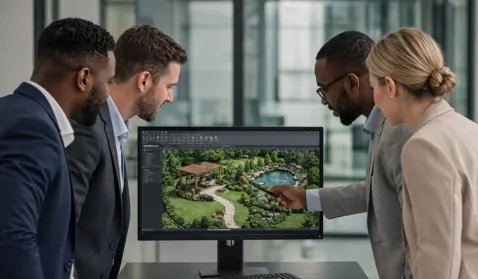
CAD drafting, SketchUp modeling, Lumion rendering, and technical documentation all follow the same pattern: high-volume production work competing with higher-value design work. Process-Smart provides dedicated, supervised design teams that increase throughput, maintain standards, and scale with your project pipeline without adding domestic headcount.


